
When a lift system fails, the consequences extend beyond downtime. An uncontrolled falling load can damage equipment, interrupt production, and create serious safety risks.
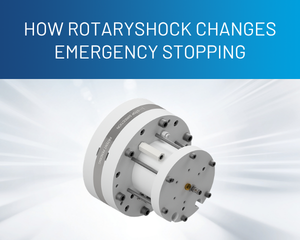
Traditional emergency stopping systems often rely on multiple braking components that increase complexity and require ongoing maintenance. The ACE Controls RotaryShock offers a different approach, providing smooth, controlled deceleration in a compact, maintenance-free package that helps protect both machinery and personnel.
A Different Approach to Emergency Stopping
Unlike conventional brake systems, the RotaryShock mounts directly to the drive shaft and remains fully disengaged during normal operation, with zero drag and zero interference. If power is lost, overspeed is detected, or a fault occurs, a spline ring engages the rotor in milliseconds. From there, oil is displaced through a progressively narrowing gap between the rotor lugs and housing, producing smooth, controlled deceleration rather than an abrupt mechanical stop. A self-compensating feature automatically increases braking force as speed increases, so deceleration stays consistent no matter how fast the load is moving when the device engages.
With a fail-safe actuator and energy capacity up to 2,700 Nm (1,990 ft-lbf), the RotaryShock is built to bring even heavy loads to a controlled stop, then hold them securely. Once engaged, the mechanical stop won’t release while under load, eliminating the risk of a second drop during recovery.
Safety devices only add value if they’re ready when they’re needed. That’s why the RotaryShock is designed as a maintenance-free system with built-in sensors that monitor the “ready” and “stopped” positions, as well as actuator disengagement, so operators always know the system’s status. An easily customizable mounting plate also makes it straightforward to adapt the device to different lift mechanisms. After an emergency stop, operators simply reverse the drive shaft to reset the device. The spline retracts automatically, sensors confirm the system is fully reset, and no disassembly or special tools are required. Recovery takes just minutes, allowing equipment to return to service quickly while reducing maintenance costs over the life of the machine.
Simplifying Lift System Design
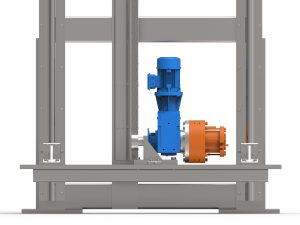
Traditional emergency stopping solutions often require multiple brakes or redundant safety components. The RotaryShock combines emergency stopping, load holding, and system monitoring into a single, pneumatically actuated device (an electric actuation option is currently in development), helping machine builders reduce complexity without sacrificing performance. The result is a cleaner design with fewer components to install, inspect, and maintain.
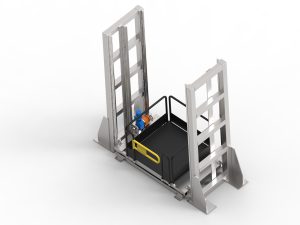
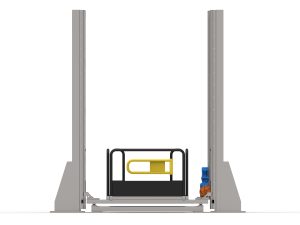
The RotaryShock is well suited for axle-driven lift and hold systems where uncontrolled descent could damage equipment or disrupt production. Potential applications include automotive VRC and assembly lifts, where a single freefall event means vehicle damage and costly downtime; overhead cranes, where it offers controlled descent in place of conventional drum or disc brake systems; automated warehouse and vertical lift module (VLM) systems, where protecting high-value inventory justifies the upgrade; and rack-and-pinion lifting systems, where it replaces brake components that otherwise need frequent replacement. Wherever heavy loads must stop safely during an unexpected failure, RotaryShock provides an added layer of protection.
A Smarter Way to Protect Your Equipment
Emergency stopping isn’t just about meeting safety requirements, it’s about protecting expensive equipment, minimizing downtime, and keeping production moving. By combining smooth deceleration, fail-safe holding, maintenance-free operation, and a simple reset process, the ACE Controls RotaryShock offers engineers a practical alternative to traditional emergency braking systems. For manufacturers looking to improve lift system safety while reducing complexity, it’s a new way to think about emergency stopping.
The RotaryShock is currently available for pre-production pilot partnerships. If you’re working on a lift or automation application where uncontrolled descent is a risk, visit acecontrols.com/contact to learn more and discuss a pilot application.