
Industrial equipment is becoming more automated, but automation does not always mean eliminating human interaction. In many applications, operators still need to open doors, lift covers, adjust equipment, or access machinery safely and comfortably.
Industrial Powerise linear actuators provide a way to automate these movements while maintaining the flexibility for manual adjustment when needed. Developed from proven automotive actuator technology, Powerise combines controlled electric movement, ergonomic operation, and flexible configuration for industrial applications.
But what exactly is POWERISE®, and how can engineers use it? Here are the answers to some of the most common questions about this linear actuator technology.
What Is Industrial Powerise?
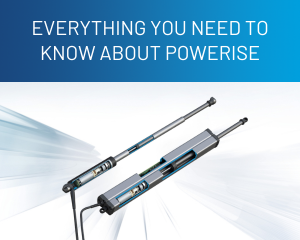
Industrial Powerise is a class of modular linear actuators designed to automate the movement of industrial components. With the push of a button, the actuators can open, close, lift, lower, or position components such as machine hoods, covers, doors, windows, and hatches. They can be configured for both horizontal and vertical movement as well as positioning applications.
The system is designed around three priorities: power, control, and ergonomics. Instead of relying entirely on manual effort or a conventional drive system, POWERISE provides controlled movement while allowing engineers to configure the system around the requirements of the application.
How Does POWERISE Work?
POWERISE uses a linear actuator to convert electrical power into controlled linear movement. Engineers can select different combinations of force, stroke, spindle pitch, and speed to create a solution suited to the application.
The system supports spindle pitches from 2 mm to 30 mm and stroke lengths from 50 mm to 350 mm. Available actuator forces range from 250 N to 4,000 N, providing flexibility for applications ranging from relatively light positioning tasks to heavier industrial components.
Powerise can also be configured with either internal or external control units. SMART models can incorporate the electronic control unit directly into the actuator, while certain configurations support communication through a CAN bus interface.
This modular approach allows engineers to select a standard configuration or develop a more customized system around specific application requirements.
What Is Powerise Used For?
Industrial Powerise can automate a wide variety of movements across industrial environments. Potential applications include:
- Machine hoods and covers
- Sliding doors
- Automatic positioning systems
- Commercial and recreational vehicles
- Manufacturing equipment
- Industrial machinery
- Medical technology
- Aerospace and marine applications
- Energy and construction equipment
- Furniture and other applications requiring controlled movement
In mechanical engineering and automation, Powerise can make it easier to open and close heavy machine hoods while improving operator ergonomics. The technology can also keep components securely open and allow operating elements to be adjusted to accommodate individual users.
The result is a solution that can address both automation and human interaction with industrial equipment.
What Are the Benefits of POWERISE®?
Powerise is designed to provide several benefits beyond simply automating movement.
Reduced manual effort: Electrical actuation can replace or reduce the physical effort required to lift, lower, open, or position components.
Ergonomic operation: Automated movement can make heavy or awkward components easier to operate, while manual adjustment remains possible when appropriate.
Maintenance-free operation: Industrial Powerise systems are designed to operate without routine maintenance throughout their intended life cycle.
Flexible integration: Standard configurations, modular components, and different control options make it possible to adapt the actuator to different applications.
Quiet operation: Industrial Powerise operates at a noise level of approximately 55 dB(A), making it suitable for applications where excessive operating noise could be a concern.
Safety and accessibility: The ability to manually adjust components can be particularly valuable when equipment needs to be accessed during a power failure or other unexpected situation.
Can Powerise Be Used Without Power?
Yes. One of the distinguishing characteristics of Industrial Powerise is its ability to accommodate manual adjustment when electrical power is unavailable.
Unlike conventional drives that may lock in position or require complicated uncoupling during a power failure, Powerise actuators are designed to allow manual operation with minimal effort.
This can be particularly useful for industrial equipment where operators or technicians need reliable access to machinery regardless of whether the actuator is powered.
Can Powerise Be Used With Gas Springs?
Yes. Powerise can be combined with gas springs to create a system that pairs powered movement with load compensation.
In this configuration, the actuator provides the dynamic force needed to move the component, while the gas spring helps compensate for the load. This can allow the system to handle heavier applications and achieve faster travel speeds while reducing the load placed on the actuator. It also supports easier manual adjustment when needed.
For ACE Controls customers, this creates an opportunity to combine Industrial Powerise with ACE NEWTONLINE industrial gas springs. Together, these technologies can provide a more complete motion solution than either component could provide independently.
How Much Force and Stroke Does Powerise Provide?
Industrial Powerise is available in a broad range of configurations to accommodate different application requirements.
| Specification | Industrial POWERISE® |
| Actuator force | 250 N to 4,000 N |
| Stroke length | 50 mm to 350 mm |
| Spindle pitch | 2 mm to 30 mm |
| Operating noise | Approximately 55 dB(A) |
| Protection | Up to IP67 |
The available combinations of force, stroke, spindle pitch, and speed give engineers significant flexibility when configuring an actuator.
The appropriate configuration depends on factors such as the component being moved, its weight and geometry, required travel, installation orientation, and desired operating speed.
What Are the Different Powerise Models?
The Industrial Powerise family includes IPR35, IPR35 SMART, IPR40, and IPR40 SMART configurations.
These models provide different combinations of actuator and control capabilities. Depending on the configuration, engineers can choose between internal and external control systems, synchronous operation of multiple actuators, and communication options including CAN bus. Certain configurations also incorporate safety functions compliant with EN ISO 13849-1.
This gives engineers the ability to select a standard solution or build a more application-specific configuration.
How Is Powerise Different From a Traditional Linear Actuator?
Powerise is designed specifically around the combination of automated movement and practical manual operation.
Its modular configuration allows engineers to specify force, stroke, spindle pitch, speed, orientation, and control requirements. The system is also designed for manual adjustment when power is unavailable, which can provide an advantage in applications where equipment must remain accessible during a power failure.
Powerise can also be combined with gas springs, creating a system in which the actuator handles dynamic movement while the gas spring provides load compensation.
How Do You Select a Powerise Actuator?
Selecting the right Powerise configuration starts with understanding the requirements of the application.
Engineers should consider:
- Required force: How much force is necessary to move and position the component?
- Stroke length: How far does the component need to travel?
- Speed: How quickly should the movement occur?
- Spindle pitch: Which spindle pitch provides the appropriate combination of speed and force?
- Orientation: Will the actuator operate horizontally, vertically, or as part of a positioning system?
- Control requirements: Does the application require an internal or external control unit, multiple synchronized actuators, or CAN bus communication?
- Manual operation: Will operators need to adjust the component when power is unavailable?
- Load compensation: Would combining the actuator with a gas spring improve the performance of the system?
Because every application is different, selecting an actuator is not simply a matter of choosing the highest available force. Application requirements, component geometry, desired movement, installation constraints, and operator needs all influence the appropriate configuration.
ACE provides application engineering support to help customers develop the right overall solution. Standard Powerise configurations are available through ACE, while customized development can be supported through the broader Stabilus Group.
Is Powerise Right for Your Application?
Industrial Powerise provides engineers with another way to approach automated movement. Rather than choosing between manual operation and a fully automated system, Powerise can combine powered movement with manual adjustability, modular configuration, and gas-spring load compensation.
For applications involving machine hoods, doors, covers, positioning systems, or other movable components, the technology can provide a practical way to improve ergonomics, accessibility, and controlled movement.
ACE Controls offers Industrial Powerise as part of its broader motion control portfolio, with standard configurations available in quantities starting from a single unit and engineering support available for application-specific requirements.
If you are evaluating a linear actuator for an industrial application, ACE Controls can help determine whether Powerise is the right solution and identify the configuration that best fits your equipment.