
In mechanical engineering, the most unpredictable variable in any system is the human element. Unlike the repeatable, programmed cycles of a robotic arm, fitness and rehabilitation equipment must manage a vast range of kinetic inputs, velocities, and force profiles, often from users with compromised joint stability. For the design engineer, the challenge is clear: how do you provide high-performance resistance while maximizing safety? The answer lies in precision motion control, where the difference between a successful recovery and a setback is measured in the smoothness of a stroke and the elimination of mechanical backlash.
For patients in rehabilitation, uncontrolled motion isn’t merely an inconvenience. It’s a clinical risk. Using traditional weights or low-quality machines risks high-impact “rebound” at the end of a range of motion. This sudden jarring can put unnecessary stress on healing tendons and joints, potentially reversing weeks of progress. To a sports physician or a therapist, “uncontrolled” means unpredictable; if a machine cannot provide smooth, bi-directional resistance, it cannot provide the safe environment necessary for a patient to push their limits without fear of re-injury.
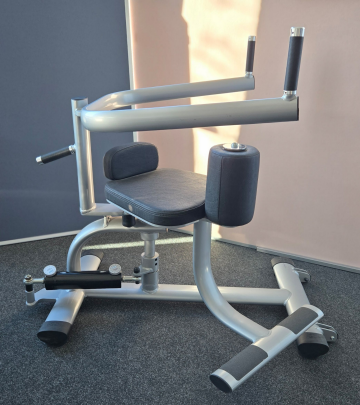
Integrating hydraulic dampers and gas springs allows for a more compact and reliable machine architecture compared to traditional friction-based or weight-stack systems. For rowing and elliptical applications, hydraulic dampers offer a bi-directional resistance solution that minimizes mechanical wear and noise. Since there are no high-friction contact points, the equipment avoids rebound entirely. In strength-training equipment, gas springs can provide a high power-to-weight ratio for supporting heavy structural elements. This ensures that the machine’s resistance is focused entirely on the intended muscle groups rather than overcoming mechanical inertia or friction, minimizing risk to vulnerable patients in rehabilitation.
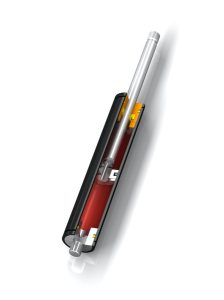
To meet the rigorous demands of sports medicine, ACE developed the HBD-70 hydraulic brake cylinder. The standout feature for design engineers is its independent adjustment elements, which allow for the fine-tuning of damping forces in both the push and pull directions. This dual-direction control is critical for rehabilitation equipment where the eccentric and concentric phases of a movement require different resistance profiles. By eliminating the “free-play” often found in lower-end dampers, the HBD-70 delivers a backlash-free performance, ensuring that resistance is instantaneous and linear from the very start of the stroke.
Choosing ACE components means more than just selecting a damper; it’s an investment in a global support network backed by a unified ecosystem. As part of Stabilus4Automation, ACE provides engineers with the peace of mind that comes from a worldwide footprint and localized service. This collective R&D powerhouse ensures that product innovations like our fitness dampers are continually evolving to meet the next generation of automation challenges. In an industry where reliability is non-negotiable, the synergy of ACE Controls and the larger Stabilus Group ensures that your equipment remains competitive, durable, and ready for the production demands of tomorrow.
Ready to optimize your equipment designs?
Don’t let unpredictable motion compromise your equipment’s performance. Contact our engineering team today to discuss how the HBD-70 or the broader Stabilus4Automation portfolio can streamline your design process and enhance user safety.